
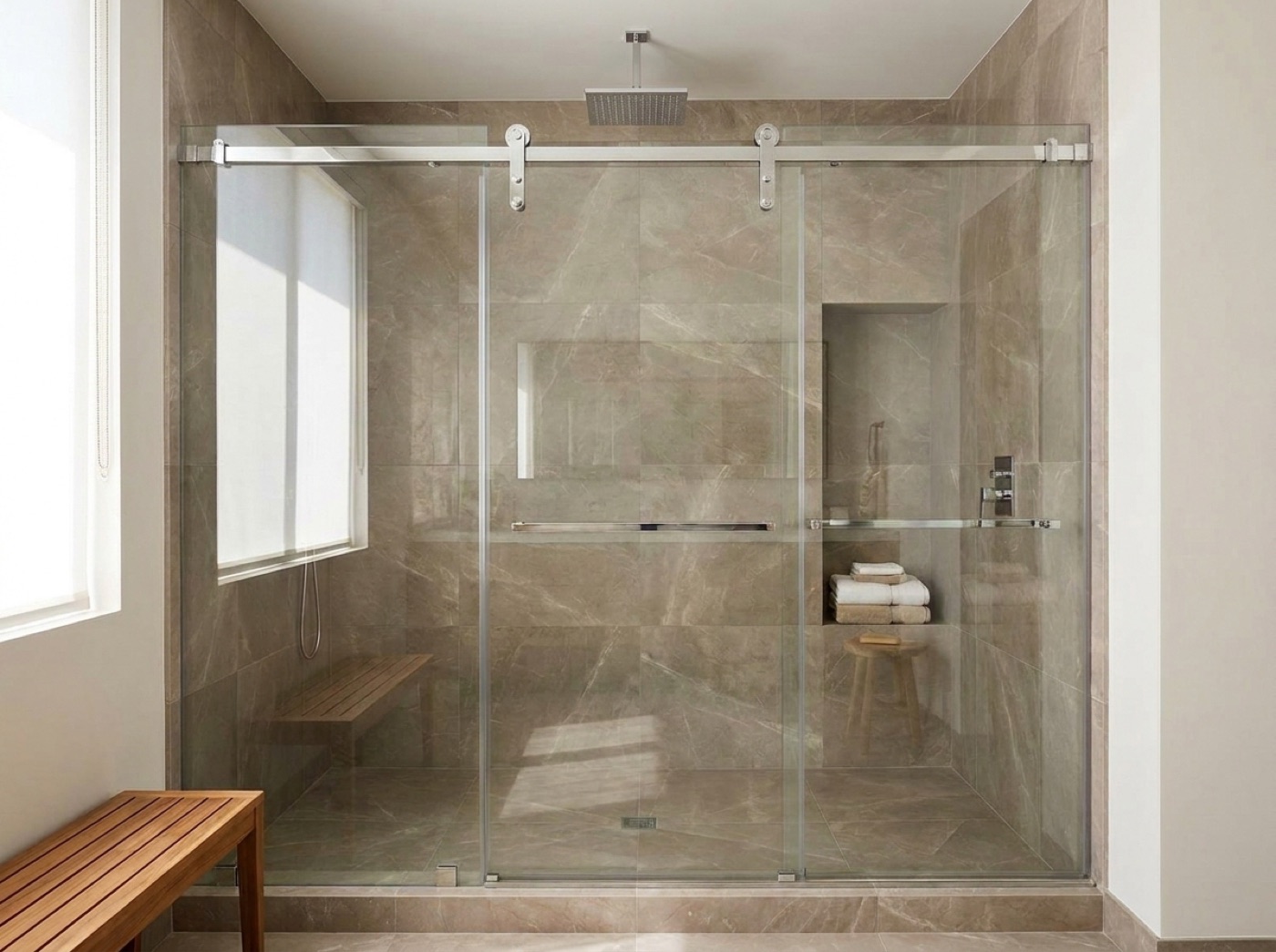
Hotel and multi-family shower specs in metro Detroit: which sliding systems survive high-traffic use
A bathroom in a single-family home gets used a few times a day by people who care about it. A hotel or apartment shower gets used hundreds of times a week by people who don't. Here's how to spec for that reality.
Residential thinking will fail you here
If you spec a multi-family or hospitality shower the way you'd spec your own master bath, you'll be replacing rollers and re-sealing units inside two years. The math is brutal: a unit that one family opens and closes maybe ten times a day might get cycled forty, fifty, sixty times a day across turnover guests, cleaning staff, and back-to-back tenants. That's not a different amount of wear. It's a different category of wear.
Multiply that by hard water, which in much of Macomb and Oakland County runs genuinely high in dissolved minerals, plus housekeeping crews wiping every surface with whatever's on the cart, and the failure points become obvious. The good news is that sliding (bypass) systems are usually the right call for these projects, and the components that survive are knowable. You just have to spec them on purpose.
Why bypass sliders win in tight, busy baths
Hotel and apartment bathrooms are small and the door has to coexist with a vanity, a toilet, and a person. A swing door needs clear arc space and a latch that closes cleanly hundreds of times without going out of adjustment. A bypass slider, two glass panels that pass each other on a header track, never swings into the room, never blocks the toilet, and has far fewer failure-prone moving parts.
Sliders also fail more gracefully. When a hinge wears, a swing door can sag, bind, or stop sealing. When a roller wears, a slider gets a little noisier and you swap a roller. For a property manager juggling dozens of units, that predictability is worth real money. It's the difference between a five-minute parts swap and pulling a whole door.
Rollers and hardware: where these systems actually die
The single biggest determinant of how long a high-traffic slider lasts is the roller assembly. Cheap systems use plated or zinc-alloy rollers that corrode and seize in a constantly wet, mineral-heavy environment. Spec stainless steel rollers and stainless or solid-brass hardware and you eliminate the most common warranty call before it happens.
A few details that separate a commercial-grade spec from a residential one:
Beyond rollers, the header track matters. Top-hung designs that carry the weight from above and use a guide at the bottom tend to run smoother and trap less hair, soap scum, and grit than bottom-rolling tracks where everything collects in the channel. Less debris in the track means less drag on the rollers, which means they last longer. It compounds.
- Sealed or serviceable roller assemblies you can replace without removing the glass
- Adjustable rollers so a unit can be re-trued after settling instead of replaced
- Anti-jump features so a yanked door doesn't derail and damage the track
- Solid-metal handles and towel bars through-bolted to the glass, not glued-on plastic
Glass, coating, and the hard-water reality
Use 3/8" tempered glass. It's the standard for a reason, and it's what we fabricate. For these projects, the bigger conversation is the surface. Untreated glass in a hard-water region clouds with mineral scale fast, and once it etches, no cleaner brings it back. A protective glass coating that sheds water and resists scale buildup keeps panels looking new far longer and, just as importantly, lets housekeeping clean them quickly without harsh chemicals.
On finishes, polished chrome and brushed nickel are the workhorses for commercial baths because they hide water spots reasonably well and tolerate frequent cleaning. Matte black and brushed gold look fantastic and we install them constantly, but on a property where crews use aggressive cleaners daily, talk through which finish holds up best for your specific cleaning protocol. The finish that survives is the one that matches how the room actually gets maintained.
Standardize the spec, simplify the building
The smartest thing an owner or GC can do across a multi-unit project is pick one system and one parts kit, then repeat it. When every unit uses the same rollers, the same track, and the same handle, your maintenance team carries one small box of spares and fixes anything in minutes. Mixed specs across floors turn a quick repair into a parts-sourcing project.
Because the same family measures, fabricates, and installs every one of our jobs in-house, we can hold a consistent spec across a whole property and adjust opening-by-opening where a stud bay or out-of-square wall demands it, without sending the work out and losing control of quality. For a metro-Detroit owner, that's the difference between a building full of doors and a building full of one well-chosen door.
Common questions.
Are sliding shower doors better than hinged for hotels and apartments?
For most high-traffic, space-tight baths, yes. Bypass sliders never swing into the room, have fewer adjustment-prone parts, and fail more gracefully: a worn roller is a quick swap, where a worn hinge can mean replacing the whole door. Hinged swing doors still make sense in larger, lower-volume openings.
What makes a shower-door system hold up under heavy daily use?
Stainless steel rollers and hardware that won't corrode in constant moisture, a top-hung track that resists grime, adjustable and serviceable parts you can repair without removing the glass, and a hard-water-resistant glass coating. Standardizing one spec across all units also keeps maintenance fast and cheap.
Can you handle a whole multi-family or hospitality project in metro Detroit?
Yes. Our family measures, fabricates, and installs every job in-house, so we can hold one consistent spec across an entire property while adjusting for out-of-square walls opening by opening. We serve Macomb and Oakland County and the wider metro-Detroit area. Reach out for a free quote.
Get a system that survives the first year and the tenth
Bring us your unit count and opening sizes and we'll help you spec a sliding system built for high-traffic, hard-water metro Detroit, then measure, fabricate, and install it in-house. Free quotes, one consistent spec across every door.