
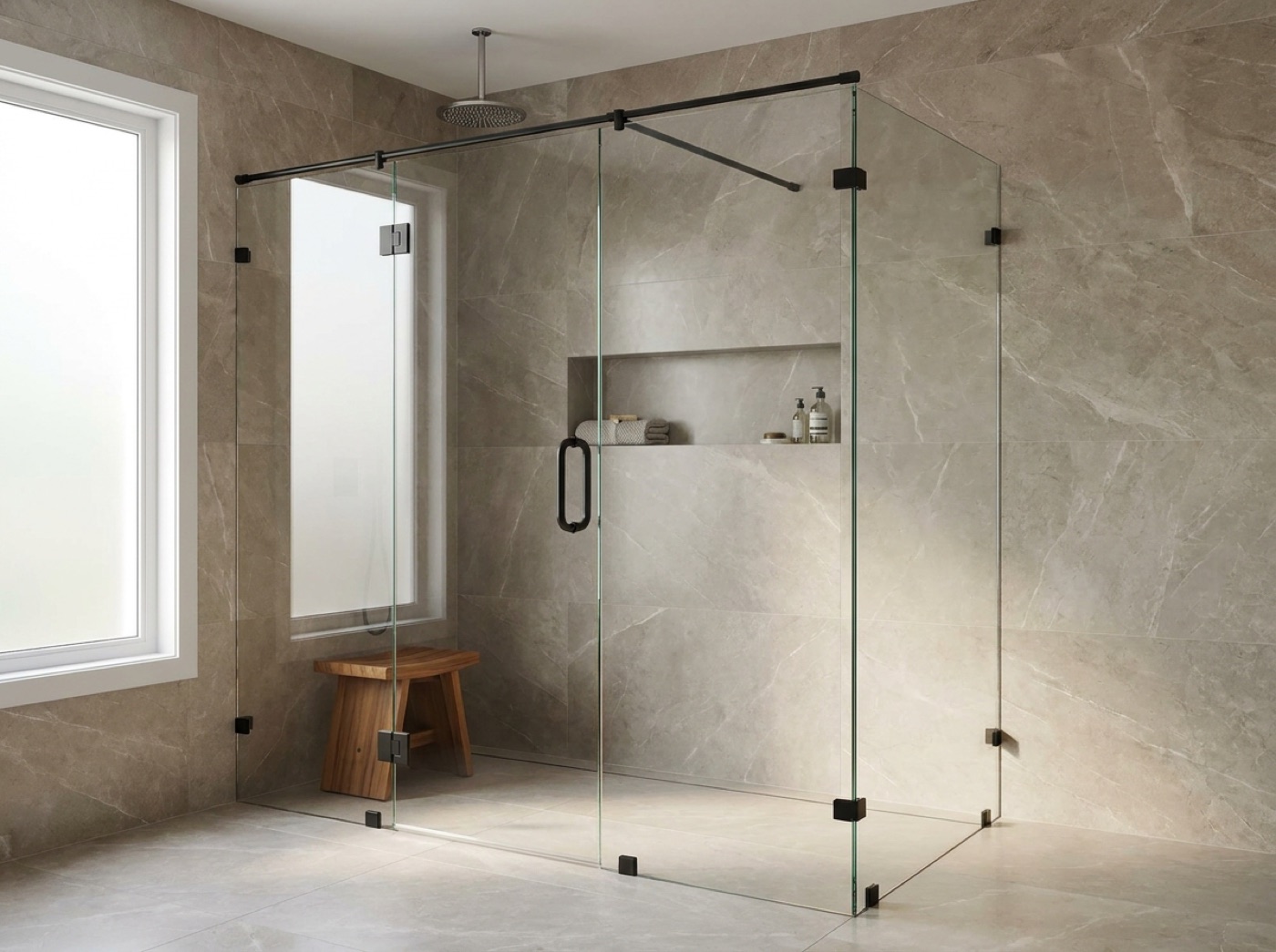
Low-iron vs standard clear: when the glass upgrade is worth it
Standard clear glass carries a faint green tint most people never notice, until they see low-iron next to it. Here's where that tint comes from and when paying for the upgrade actually pays off.
The green tint nobody warns you about
Stand a piece of standard clear shower glass on its edge and look through the thickness. You'll see it: a soft green cast, like looking into the shallow end of a pool. That color comes from iron oxide that occurs naturally in the sand used to make float glass. It's been there the whole time. You just never caught it because you were looking through the pane, not into the edge.
Low-iron glass (you'll hear brand names like Starphire, Krystal Clear, or UltraClear) is made with a low-iron sand and extra processing that strips most of that oxide out. The result is glass that reads truly colorless, with a clean blue-white edge instead of a green one. On a 3/8-inch shower panel, the difference is real, but whether it's worth the upcharge depends entirely on what you're putting behind the glass.
Where the tint actually shows up
Two things make the green more or less obvious. The first is glass thickness and panel length: light has to travel through more material in a tall frameless 3/8-inch enclosure than in a short framed door, so the color stacks up. A long fixed panel and a swing door viewed edge-on is where you'll notice it most.
The second and bigger factor is what's behind the glass. Tint reads as a subtle shift against whatever color it's layered over. Put clear glass in front of pure white subway tile, a Carrara marble slab, or a crisp white-and-gold scheme, and that green haze quietly mutes everything. The white goes slightly cool, the marble's warmth flattens, the gold hardware reads a touch off. That's exactly the look people are trying to achieve when they spend on those finishes, and the standard glass is working against it.
When the low-iron upgrade is worth it
Reach for low-iron when the glass is meant to disappear and let an expensive finish speak. The upgrade earns its keep over light natural stone, true-white tile, soft neutrals where color accuracy matters, and any scheme built around brushed gold or polished chrome hardware that you want reading clean.
It's also the right call for big, statement frameless enclosures, the kind that act like a wall of glass across a master bath. The more glass you're looking through, the more a low-iron panel rewards you with that water-clear, almost invisible quality. If you've invested in a showpiece bathroom, this is usually the last small upgrade that protects everything else you paid for.
- Light marble, quartz, or natural stone surrounds
- Pure white or very pale tile
- Brushed gold or chrome hardware you want true to color
- Large frameless walls of glass where clarity is the whole point
- Designer color schemes where the finish has to read accurately
When standard clear is the smarter spend
Just as often, the upgrade is money you don't need to spend. If your tile is gray, greige, beige, dark, or has a busy pattern, the faint green tint simply has nothing to contrast against and effectively vanishes. Nobody walking into the room will ever see it.
Standard clear is also the practical pick for smaller framed or sliding enclosures, alcove showers, secondary and guest baths, and rental or resale projects where you want a clean look without paying for a difference no one will notice. The glass is still beautiful, still fully tempered, still 3/8-inch on our frameless work. It's a question of where your budget does the most good, and over the right backdrop, clear and low-iron are genuinely hard to tell apart.
One thing low-iron does not fix
A common assumption is that low-iron glass is somehow easier to keep clean or more resistant to spotting. It isn't. Both types are the same smooth tempered glass and both will collect the same hard-water film that's a fact of life around metro Detroit. What protects either one is a quality surface treatment and a quick daily squeegee, not the iron content.
So separate the two decisions. Choose low-iron for clarity when the backdrop calls for it, and choose a protective coating for maintenance regardless of which glass you pick. They solve different problems, and getting them confused is the most common mix-up we untangle in the showroom. The easiest way to decide is to see both side by side against a sample of your actual tile, which is exactly what a sample in hand lets you do.
Common questions.
Is low-iron glass worth the extra cost?
It's worth it when the glass sits in front of light marble, white tile, true whites, or hardware finishes you want reading true to color, and on large frameless enclosures where clarity is the whole point. Over gray, beige, dark, or busy tile, the green tint of standard clear effectively disappears and the upgrade isn't necessary.
Why does my clear shower glass look green?
That green comes from iron oxide naturally present in the sand used to make standard float glass. You see it most on the cut edge and on thicker, taller panels, and it reads as a subtle haze when layered over white or very light surfaces. Low-iron glass removes most of that iron for a truly colorless look.
Does low-iron glass resist hard water or stay cleaner?
No. Low-iron and standard clear glass are the same smooth tempered surface and collect the same hard-water spotting common in metro Detroit. Easy cleaning comes from a protective coating and a daily squeegee, not from the iron content of the glass.
Compare low-iron and clear against your own tile
Bring a tile sample or a few photos to our Sterling Heights showroom and we'll set both glass types side by side so you can decide with your eyes, not a brochure. Free quotes, measured and installed by the same family.