
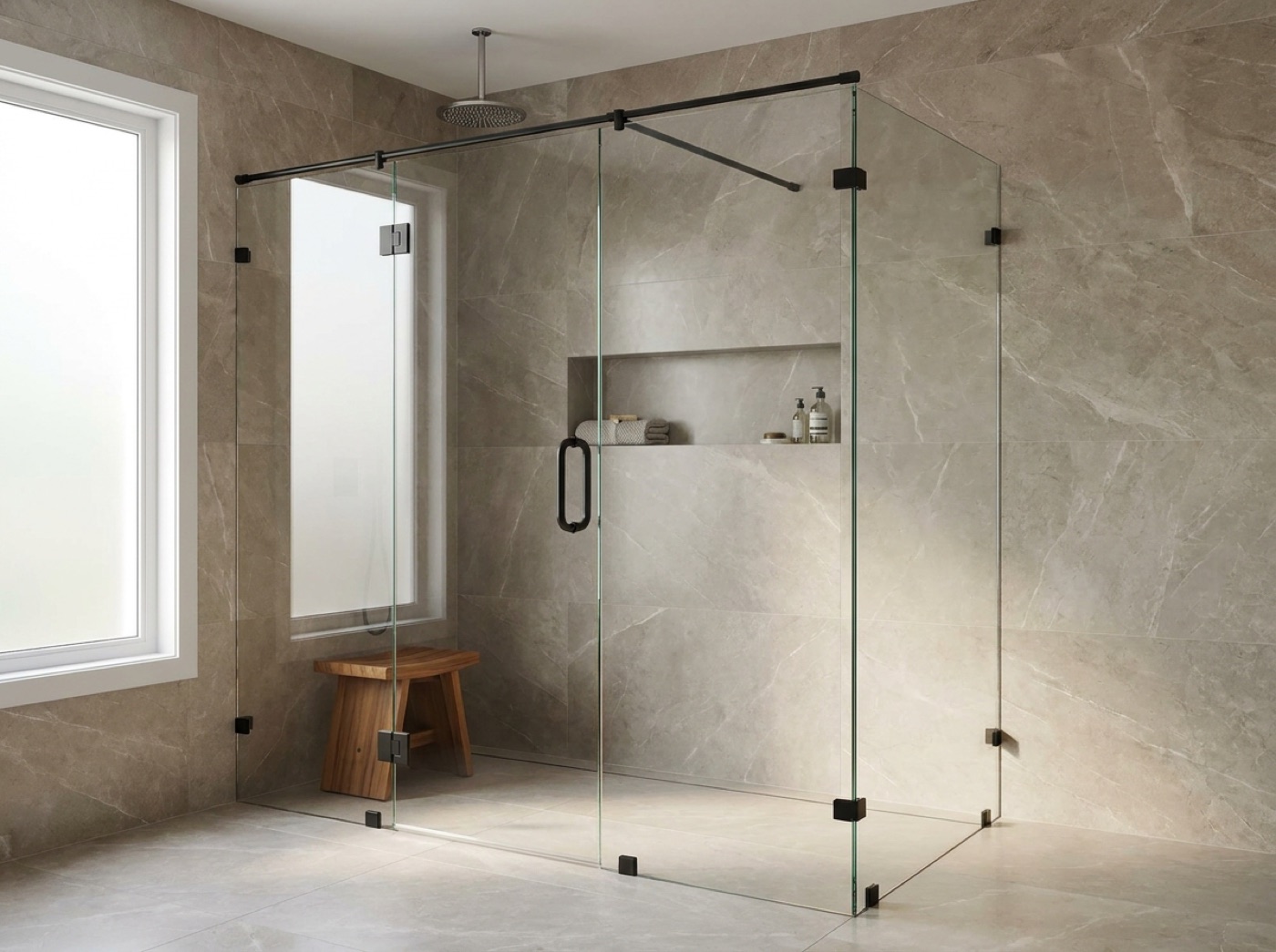
Michigan shower door codes made simple: safety glass labels for Macomb and Oakland County projects
What that tiny etched stamp in the corner of your glass actually means, why it matters, and how building code shapes a real shower-door install. General guidance, not legal advice.
The little stamp that says a lot
Look in the bottom corner of any glass shower panel and you'll usually find a small etched or sandblasted logo with a string of letters and numbers. Most people never notice it. But that tiny mark is the single most important code detail on your whole enclosure, and once you know how to read it, you can spot a safe, properly built shower door in about three seconds.
In Michigan, shower and tub enclosures are hazardous locations under the building code, which means the glass has to be safety glazing. That stamp is the manufacturer's way of certifying it is. Here's what it means in plain English, and how it shapes the way we measure, fabricate, and install here in Macomb and Oakland County.
Why showers count as a "hazardous location"
Building codes single out a handful of spots where glass is more likely to get bumped, slipped into, or fallen against, and they require safety glazing in all of them. Doors, sidelights, low windows near floors and stairs, and anything in or around a bathtub or shower all make the list.
The logic is simple. A wet, often crowded space with bare feet and slick surfaces is exactly where you don't want ordinary annealed glass, which breaks into long, sharp daggers. Safety glazing is engineered to fail safely instead, and the etched label is the proof that it does.
How to read the etched label
A typical shower-glass stamp packs several facts into a small space. Once you know the parts, it reads like a spec sheet:
Most residential shower enclosures use Category II glazing, the higher-impact rating, because it's the safe choice for full-height doors and panels. If you can find and read this stamp, the glass has been certified to one of these standards.
- The manufacturer's name or logo, so the source is traceable.
- 16 CFR 1201, the federal safety-glazing standard, often with "CAT I" or "CAT II" for the impact category.
- ANSI Z97.1, a widely referenced consensus safety-glazing standard.
- "Tempered" or "Temp," plus the nominal thickness (you'll commonly see 3/8").
Why tempered glass is measured before it's made
Here's a detail that surprises a lot of homeowners: tempered glass cannot be cut, drilled, or notched after it leaves the oven. The tempering process locks the whole panel under tension, so any attempt to alter it shatters it.
That means every dimension, every hinge cutout, and every hardware hole has to be exact before the glass is fabricated. A frameless door that's off by an eighth of an inch isn't trimmed on site, it's a remade panel. This is the real reason precise, in-person measuring matters so much, and why we measure, fabricate, and install in-house rather than passing your project between three different companies. The fewer hands between the measurement and the install, the fewer surprises.
Permits, plumbing, and what's usually in scope
The most common question we hear is whether a shower door needs a permit. The honest answer is that it depends on the work, and your local building department has the final say. As a general rule of thumb, swapping or installing a glass enclosure on an existing, finished opening is a fixture-level job. The moment you start moving plumbing, relocating drains, or altering structural walls, you're in permit territory, and that's usually handled by the contractor doing the tile or plumbing work.
Where the code most directly touches the glass itself is the safety glazing requirement, the secure anchoring of panels and hardware into solid blocking, and proper clearances so a door can open without striking a fixture. We build to those points regardless of permit status, because they're what keep a heavy glass door safe for years. If your project is part of a larger remodel, loop in your general contractor or the building department in your city, whether that's Sterling Heights, Troy, Rochester Hills, or anywhere else across Macomb and Oakland County.
What this means for your install
You don't need to memorize code sections to get a safe, well-built shower. You just need to know the non-negotiables: the glass is tempered safety glazing with a readable etched label, it's the right thickness for the door style, and it's anchored into solid backing, not just tile and thinset.
When you work with an installer who handles measuring, fabrication, and installation under one roof, those details get checked as a matter of course. The label isn't an afterthought, it's part of how a real shower door earns its place in a wet, busy bathroom.
Common questions.
Does a shower door need a permit in Michigan?
It depends on the scope of work, and your local building department has the final word. Installing or replacing a glass enclosure on an existing, finished opening is typically a fixture-level job. Once you move plumbing, relocate a drain, or alter walls, a permit is usually required, and that's normally handled by the contractor doing the plumbing or tile work. When in doubt, call your city's building department.
What does the etched label in the corner of my shower glass mean?
It's the manufacturer's certification that the glass is safety glazing. It typically shows the maker's logo, a standard such as 16 CFR 1201 (often noting Category I or II) and/or ANSI Z97.1, the word 'Tempered,' and the thickness. In a shower you want Category II tempered glass.
Can tempered shower glass be cut to fit on site?
No. Tempered glass cannot be cut, drilled, or notched after it's made, or it will shatter. Every dimension and hardware cutout is set before the glass is tempered, which is exactly why precise in-person measuring is so important to a clean frameless install.
Get a free, precise quote from a team that measures, makes, and installs in-house
Visit our Sterling Heights showroom or call (586) 315-8900. We handle the code-critical details so your Macomb or Oakland County shower door is safe, square, and built to last.